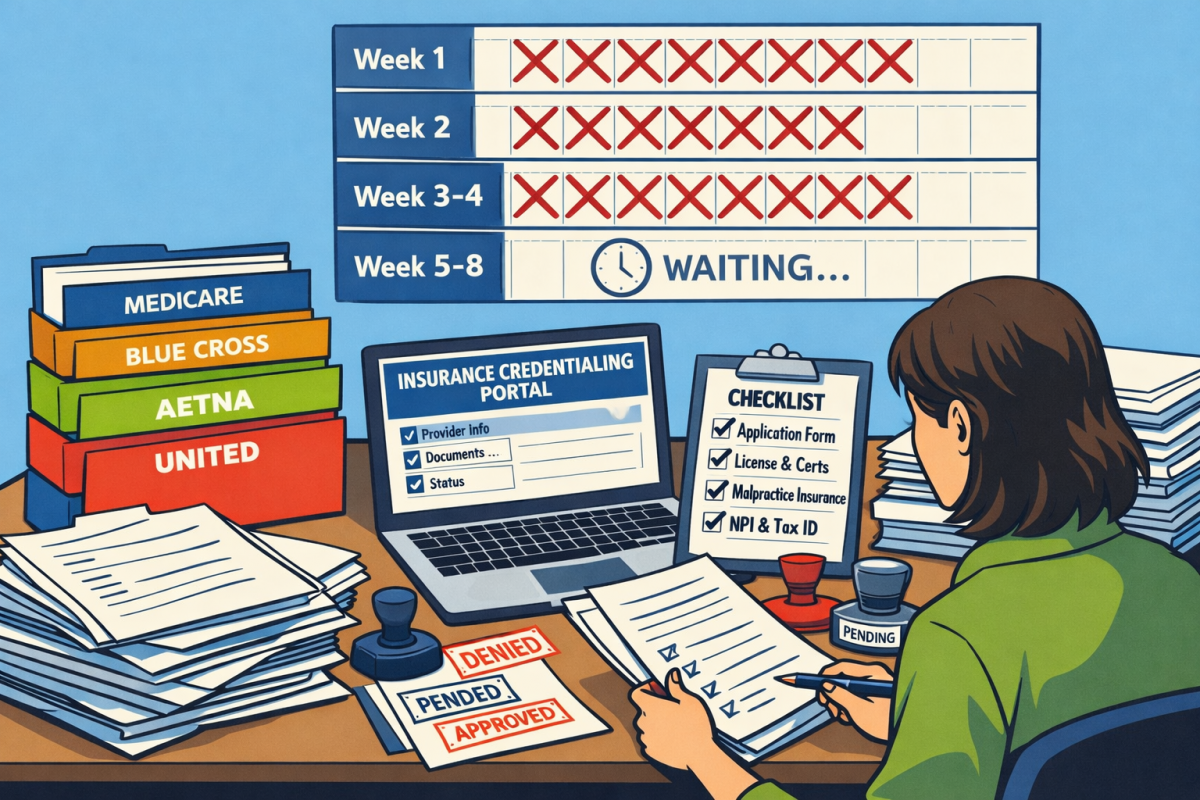
Most practices hear “about 90 days” and plan around that. In real life, the timeline depends on which payors you are working with, how complete your information is, and where you are starting from. This overview gives you a more honest picture of what to expect.
The clock does not start when you think it does
The timeline most payors quote begins when they receive a clean, complete application, not when you start gathering documents or fill out your first form.
In practice, getting from “we need to credential” to “applications are submitted” usually takes two to four weeks on its own. That prep time is not counted in anyone’s timeline estimates, but it is real time your practice is waiting.
So when someone says “60 days,” a more realistic read is:
- Two to four weeks of document gathering and prep
- Plus the payor’s processing time, in business days, not calendar days
- Plus any back and forth on missing information or requests for clarification
That 60 day window starts to look a lot more like three to four months on the calendar before a provider is approved and billing.
What “business days” actually means
Payors process applications in business days. Weekends, federal holidays, and internal processing queues do not count against their quoted timelines.
A quoted 90 business day window translates to roughly 18 calendar weeks, or about four and a half months, before you factor in any delays. Most practices do not realize this until they are already waiting.
Realistic timelines by payor type
These ranges reflect what practices typically experience in the field. Every case is different, and clean submissions with complete information will generally land on the shorter end.
Starting new vs transitioning from another practice
Where you are starting from matters as much as which payor you are targeting.
Starting from scratch means applying to every payor for the first time. You are building your payor relationships from zero, and there is no existing enrollment history to pull from. Expect to be near the longer end of every range in the table above.
Transitioning from another practice means you may already be enrolled with some payors under a different group or tax ID. That history does not automatically transfer. Each payor treats a new practice or new tax ID as a new application, which surprises a lot of providers who assume their existing relationships carry over.
Adding a new provider to an existing practice is usually faster than starting from scratch, but still requires individual applications for each payor and each provider. It is not automatic, even if the practice is already in network.
Effective dates and what that means for billing
Getting approved is not the same as being able to bill. Your effective date is the date a payor officially recognizes you as in network. Services before that date are generally not billable to that plan, regardless of when you actually started seeing patients.
A few nuances worth knowing:
- Medicare allows retroactive effective dates, meaning your billing effective date can go back up to 30 days before your approval date if your application was submitted cleanly and approved without issues.
- Medicaid retroactive billing rules vary by state. Some allow it, some do not, and some have narrow windows.
- Most commercial payors do not offer retroactive effective dates. If you start seeing patients before approval, those visits are typically not reimbursable under that plan later.
This is one of the clearest reasons to start the credentialing process as early as possible. Every week you wait to apply is a week of potential revenue you cannot recover once approved.
What adds time
Even within these ranges, certain things reliably push timelines toward the longer end:
-
Starting the process after a provider is already seeing patients
-
Incomplete or inconsistent information across applications and payor profiles
-
Submitting through the wrong product or pathway for a given payor
-
Outdated licenses, malpractice coverage, or CAQH profiles
-
Slow responses to payor questions or requests for additional documentation
-
Panel closures that require a waitlist or separate process to get on
None of these are unusual. They are part of why clean, organized submissions make a real difference.
How to plan against real timelines
A few rules of thumb that hold up in practice:
-
Treat 90 days as the minimum, not the target.
-
Count in calendar weeks, not business days.
-
Start the process before you think you need to, ideally 4 to 6 months before a provider needs to be billing.
-
Build in time for at least one round of back and forth with each payor.
-
Do not assume approvals will arrive at the same time for all payors.
If you are hiring, opening a location, entering a new state, or launching a practice, the credentialing timeline should be one of the first things on the planning list, not the last.
At pie Health, we build a realistic timeline into every engagement so you know what to expect, payor by payor, before applications go in. If you want to talk through what your timeline might look like, we are always open to a short conversation.