Something significant happened in U.S. healthcare in January 2026. It received almost no coverage in provider-facing media. And if your practice relies on CAQH for credentialing — which it almost certainly does — it affects you directly.
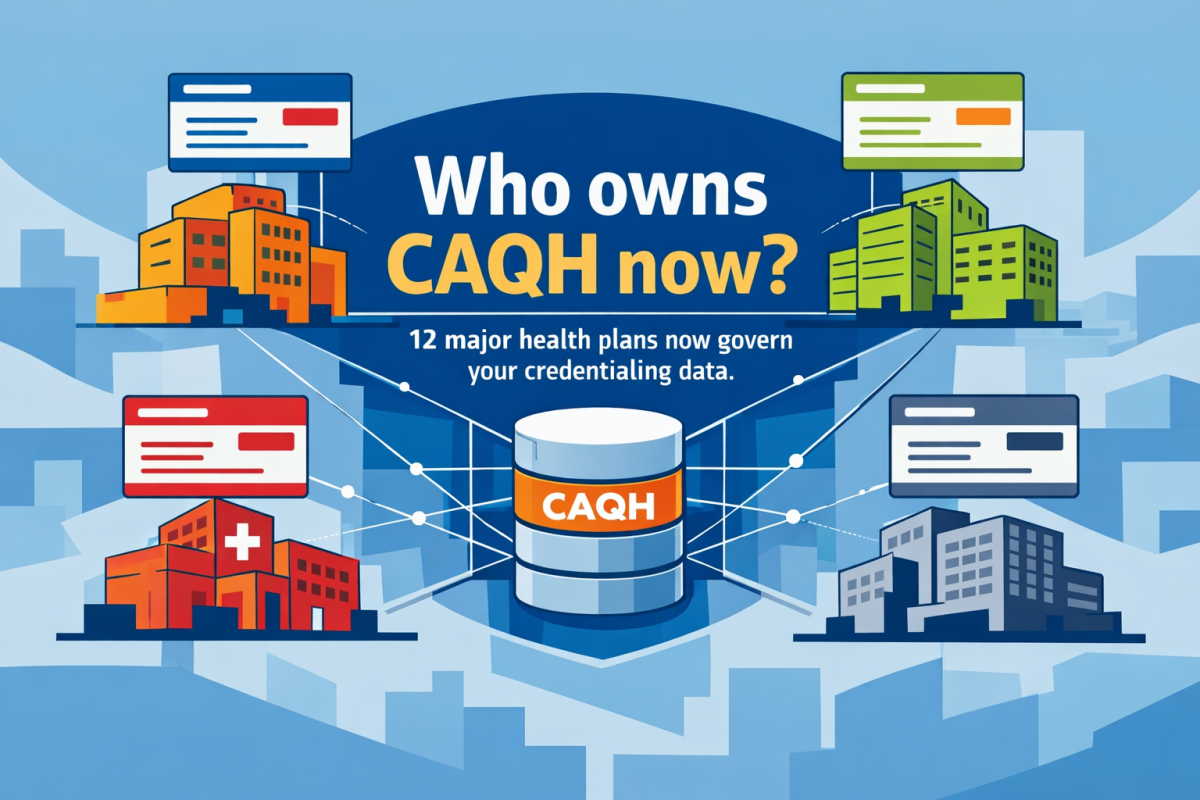
CAQH, the Council for Affordable Quality Healthcare, announced that it is now owned by twelve shareholder companies affiliated with the nation’s leading health plans. This is not a partnership or a sponsorship arrangement. These are owners, with board representation, governance authority, and strategic direction over the platform.
For more than 25 years, CAQH functioned as a neutral industry utility — a shared infrastructure that providers and payers both depended on. That structure no longer exists. CAQH is now a payer-governed data system, and the operational implications for your practice are real.
What Happened: CAQH’s Ownership Changed in January 2026
CAQH’s announcement, published January 6, 2026, confirmed that twelve shareholder companies now own the organization. The new CAQH Board of Directors is composed entirely of representatives from those shareholder health plans:
- Tim Kaja — UnitedHealth Group (Board Chair)
- Susan Smith — Centene Corporation (Vice Chair)
- Jessica Conley — Aetna, a CVS Health company
- Paul Eisenstat — Elevance Health
- Sachin Joshi — The Cigna Group
- Oraida Roman — Humana Inc.
- Heather Staples — Horizon Blue Cross Blue Shield of New Jersey, representing the collective interests of CareFirst BlueCross BlueShield, Horizon, Blue Cross Blue Shield of Michigan, Blue Cross Blue Shield of North Carolina, and BlueCross BlueShield of Tennessee
That board is the governing body for a platform that holds more than 4.8 million provider data records and member data covering 75% of U.S. covered lives. CAQH ProView — the provider-facing portal where clinicians maintain their credentials, licenses, and practice information — is now governed by the same organizations that use that data to make credentialing, directory, and payment decisions.
The official rationale is straightforward: deeper payer partnerships, accelerated product development, and more investment in data infrastructure. That may well happen. But for providers, the more immediate question is what it means operationally when the payers who decide whether to credential you, list you in their directories, and pay your claims are also the owners of the platform that holds your data.
Why This Matters for Every Credentialed Provider
CAQH has never been just a form you fill out once a year. It sits upstream of multiple workflows that directly affect your revenue:
- Provider directory publishing — payers pull your specialty, location, and contact data from CAQH to populate their member-facing directories
- Credentialing and re-credentialing eligibility — most major health plans use CAQH ProView as the primary source of record when processing credentialing applications
- Network enrollment status — CAQH data is used to verify and maintain your active participation in payer networks
- Claims validation — payer systems cross-reference CAQH data against claims to verify provider identity and enrollment status
When a neutral third party governed this system, data inaccuracies were inconvenient. Administrative staff sent follow-up requests. Applications got delayed. Corrections were made. The process was slow but forgiving.
That tolerance is narrowing. As Rachel McVey, Senior Director of Provider Enrollment at Ventra Health, wrote in January 2026: “When payer interests shape the governance of this platform, the tolerance for data inaccuracies may decrease.” Her analysis goes further: “Ventra teams are already seeing payers use CAQH status as a live enforcement mechanism. In multiple payer systems, providers must maintain active CAQH re-attestation, complete government program identifiers, and accurate location data in order to remain credentialed, eligible for products, and payable.”
This is not speculation about future policy. It is a description of what is already happening in 2026.
The Revenue Impact: How Payer Ownership Changes CAQH Enforcement
CAQH requires providers to re-attest their data at least every 120 days — roughly once per quarter. If a provider fails to re-attest within that window, their profile is marked inactive. That single status change can trigger a cascade of downstream effects:
1. Directory removal. Payers refresh their provider directories using CAQH data. An inactive profile can cause your listing to go dark — meaning patients searching for an in-network provider won’t find you. This happens without notification, and correcting it requires both reactivating your CAQH profile and waiting for the payer to refresh their directory, which can take weeks.
2. Credentialing delays. When your practice adds a new provider or processes a re-credentialing application, payers check your CAQH profile. If the profile is inactive or contains expired data — a lapsed license, an old address, a missing NPI — the application stalls. In 2026, that stall is longer and less forgiving than it used to be.
3. Claims holds and denials. For payer systems that now use CAQH status as a real-time enrollment signal, a lapsed profile creates direct exposure to claim holds. This is the revenue impact that most practices don’t see coming — because by the time claims are affected, the CAQH lapse happened weeks earlier and the connection isn’t obvious.
4. Enrollment delays for new payer contracts. If you’re bringing a new provider on staff, expanding to a new location, or contracting with a new health plan, an outdated CAQH profile can delay the entire onboarding process by weeks. In a payer-owned environment, that delay is not the payer’s problem. It’s yours.
The compounding issue is that most practices don’t know when their CAQH profile lapses. Attestation reminders go to whoever maintains the profile — often a credentialing coordinator, an office manager, or in smaller practices, whoever set it up years ago. Staff turnover, changed email addresses, and quarterly re-attestation fatigue mean lapses happen constantly. Under neutral CAQH governance, those lapses were correctable. Under payer-owned governance, they are increasingly consequential.
What Your Practice Should Do Right Now
The operational response to this ownership change is straightforward — but it requires treating CAQH maintenance as a revenue continuity task, not a compliance formality.
1. Check your CAQH profile today. Log in at proview.caqh.org and check your attestation date. If it’s been more than 120 days, re-attest now. If your profile contains any outdated information — an old address, a license that has since been renewed, a missing or incorrect NPI — update it before re-attesting.
2. Audit every provider in your practice. Each individual clinician has their own CAQH profile. Group attestation is not sufficient. Audit every provider by name, check their individual attestation status, and flag anyone who is past due or approaching the 120-day window.
3. Set 90-day internal reminders — not 120. The official re-attestation window is 120 days, but waiting until day 119 creates unnecessary risk. Set internal calendar reminders at 90 days to give your team time to gather updated documents, confirm information with providers, and complete attestation before the window closes.
4. Cross-check CAQH against payer portals. Discrepancies between your CAQH profile and what payers have on file in their own portals are increasingly common — and increasingly consequential. Spot-check your top three payers by logging into their portals and comparing what they show against your CAQH profile. Pay particular attention to practice locations, tax identification numbers, and specialty codes.
5. Assign ownership. Someone in your practice needs to own CAQH maintenance as a named, accountable responsibility. Not “whoever handles credentialing.” A named person with a defined schedule. If your practice doesn’t have that person, you have a revenue continuity risk.
How pie Health Manages CAQH for You
At pie Health, we don’t treat CAQH as an afterthought. CAQH monitoring and attestation management are built into our enrollment operations — which means we’re tracking your re-attestation window, reconciling your profile against payer portals, and flagging discrepancies before they become enrollment blocks or claim denials.
When CAQH’s ownership changed in January, we updated our monitoring protocols to reflect the new enforcement environment. We’re watching for the faster enforcement cadence that payer-owned governance enables — and we’re keeping our clients ahead of it.
If your practice is managing CAQH manually, or if you’re not sure when your last attestation was, that’s worth addressing now. The cost of a lapsed profile — in delayed claims, directory removals, and credentialing stalls — is significantly higher in 2026 than it was even six months ago.
Book a consultation with pie Health →
Sources: CAQH ownership announcement (caqh.org/blog, January 6, 2026); Ventra Health provider enrollment analysis (ventrahealth.com, January 26, 2026); CAQH ProView provider user guide (caqh.org). pie Health does not have a financial relationship with any of the referenced organizations.